Below, port and starboard views (what.... you were expecting maybe "left" and "right"?) of another bellrope that Chief Considine
made for a retiring Master Chief. What a NICE retirement gift and how the Chief's eyes must have shone.
A word about that: Among seafaring men, a gift like this speaks absolute worlds about the respect in which the recipient is held by
the giver. I have seen hard-bitten men who sailed the oceans of the world for thirty-five years reduced to tears when given
something similar upon retirement or leaving the ship. Those who follow the sea understand the hours of labour and care that go
into a beauty like Chief Considine's bellrope above and to be given such a thing is a real accolade from one's peers.
For a retiring seaman, a newly promoted Officer or a new Chief Petty Officer, there is no finer gift than one of fancywork.
That said, here are a series of four photos of something equally interesting: it is a "centerpiece mat" that the Chief made up.... they
were "busy work" gifts which were made by sailormen of old on a voyage and then presented to their loved ones when back home
again.
made for a retiring Master Chief. What a NICE retirement gift and how the Chief's eyes must have shone.
A word about that: Among seafaring men, a gift like this speaks absolute worlds about the respect in which the recipient is held by
the giver. I have seen hard-bitten men who sailed the oceans of the world for thirty-five years reduced to tears when given
something similar upon retirement or leaving the ship. Those who follow the sea understand the hours of labour and care that go
into a beauty like Chief Considine's bellrope above and to be given such a thing is a real accolade from one's peers.
For a retiring seaman, a newly promoted Officer or a new Chief Petty Officer, there is no finer gift than one of fancywork.
That said, here are a series of four photos of something equally interesting: it is a "centerpiece mat" that the Chief made up.... they
were "busy work" gifts which were made by sailormen of old on a voyage and then presented to their loved ones when back home
again.
| David CONSIDINE BMCS, USCG |

| Last updated 2007-11-30 |
| Click on any picture to bring up a larger version! |
| (Before people write me on it, much of this IS on the "military" page.... but Chiefie is continuing to do things all the time so I started this page!) |
David Considine is a Senior Chief Boatswain's Mate in the U.S. Coast Guard and is currently 'Officer In Charge' of a CG station in
Massachusetts. He has been corresponding with me for a few years and his work is some of the nicest I've ever seen. It is a pleasure
to put up this page to display his craft.
Massachusetts. He has been corresponding with me for a few years and his work is some of the nicest I've ever seen. It is a pleasure
to put up this page to display his craft.

Let's start with one of the most important items to a Chief Petty Officer in just about ANY naval
Service: his HAT. The hat is a symbol of the CPO's rank, and also a reminder that he has
achieved a position of respect and responsibility which is difficult to convey to the civilian. The
Chief is (all respects to the Officers aboard) the man who is REALLY in charge of the various
functions of the ship. He is the grease that makes the gears go 'round, the final source of
knowledge for all hands (if the Chief says that's how it works, then you can believe that "That
s How It Works"), the man who really controls the crew and the day-to-day operation of the
particular division of the ship's workforce, the real "go-to" guy in any emergency.
I could go on, but essentially the CPO IS the Service. When he achieves his rank of Chief, he is
given his first hat, and anyone who has NOT 'made' Chief cannot really understand the true
importance of this object to him. Suffice it to say it's like his diploma.
Service: his HAT. The hat is a symbol of the CPO's rank, and also a reminder that he has
achieved a position of respect and responsibility which is difficult to convey to the civilian. The
Chief is (all respects to the Officers aboard) the man who is REALLY in charge of the various
functions of the ship. He is the grease that makes the gears go 'round, the final source of
knowledge for all hands (if the Chief says that's how it works, then you can believe that "That
s How It Works"), the man who really controls the crew and the day-to-day operation of the
particular division of the ship's workforce, the real "go-to" guy in any emergency.
I could go on, but essentially the CPO IS the Service. When he achieves his rank of Chief, he is
given his first hat, and anyone who has NOT 'made' Chief cannot really understand the true
importance of this object to him. Suffice it to say it's like his diploma.
Chief Petty Officer's Hat box decoration by Chief Boatswain's Mate David Considine, USCG (O.I.C. of Chatam MA USCG Facility.)
"This is the anchor I made for my Chief's Initiation hat box. I basically tied the rope anchor that is the frontispiece of the
'Encyclopedia of Knots and Fancy Rope Work' by Graumont and Hensel. Since the Coast Guard Chief's Anchor has the shield I
had originally planned on making the shield overlay the anchor. That was almost impossible... I ended up cutting the shank of the
anchor in two and used a wood cutout of the shield to place in between the new top and bottom. For the shield I used several
different sennits and straight ropes."
"This is the anchor I made for my Chief's Initiation hat box. I basically tied the rope anchor that is the frontispiece of the
'Encyclopedia of Knots and Fancy Rope Work' by Graumont and Hensel. Since the Coast Guard Chief's Anchor has the shield I
had originally planned on making the shield overlay the anchor. That was almost impossible... I ended up cutting the shank of the
anchor in two and used a wood cutout of the shield to place in between the new top and bottom. For the shield I used several
different sennits and straight ropes."
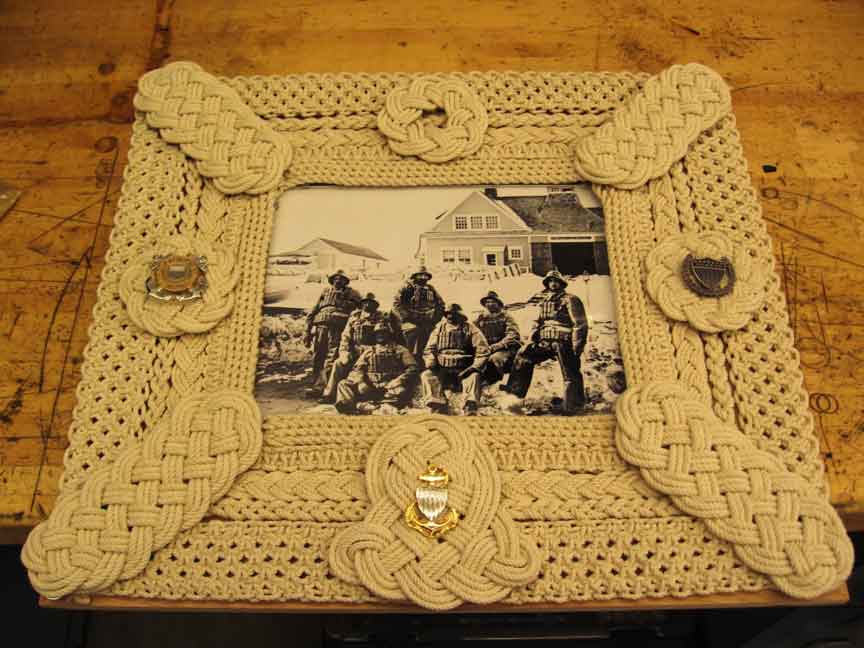
A picture frame that Chief made... the picture inside is of a Coast Guard
Lifesaving Crew around the turn of the 20th century, somewhere in
Massachusetts.
The frame has several different sennits applied to a board backing and
then small mats and turksheads are applied over them as decorations.
This one is not completed as shown; David had not yet done the "edging"
sennit to hide the rest of the board backing, but you can easily see how
pretty this will be when fully done.
Picture frames have long been a tradition among seamen and some are
enormous and incredibly intricate. It IS somewhat a dying art.
I could tell you how he did it, but then I'd have'ta drown ya!
Lifesaving Crew around the turn of the 20th century, somewhere in
Massachusetts.
The frame has several different sennits applied to a board backing and
then small mats and turksheads are applied over them as decorations.
This one is not completed as shown; David had not yet done the "edging"
sennit to hide the rest of the board backing, but you can easily see how
pretty this will be when fully done.
Picture frames have long been a tradition among seamen and some are
enormous and incredibly intricate. It IS somewhat a dying art.
I could tell you how he did it, but then I'd have'ta drown ya!
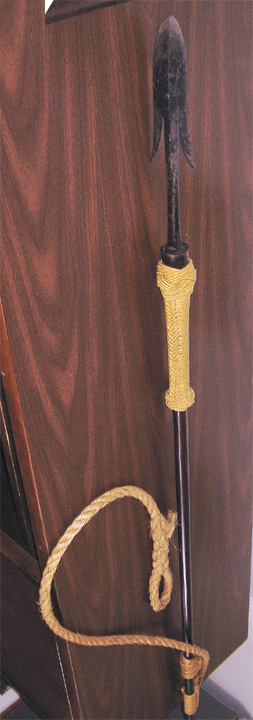
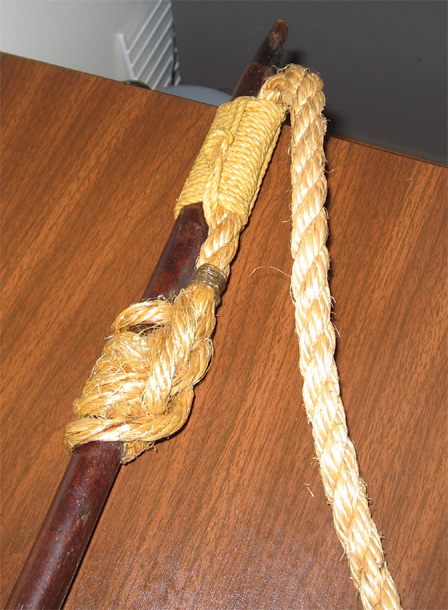
"I had done this for my brother ten years ago
while underway on a Coast Guard Cutter. He
had received the harpoon from a friend and
asked if I could put some fancy work on it.
Looking through Ashley I found what he had for
Harpoon fancywork. I didn't want to drill through
the wood so I did the best to secure the trail line
in accordance with the pictures in Ashley* (#2062
and 2063) making the mount on the handle
rather than the actual iron. "
(*The Ashley Book of Knots" by Clifford Ashley)
while underway on a Coast Guard Cutter. He
had received the harpoon from a friend and
asked if I could put some fancy work on it.
Looking through Ashley I found what he had for
Harpoon fancywork. I didn't want to drill through
the wood so I did the best to secure the trail line
in accordance with the pictures in Ashley* (#2062
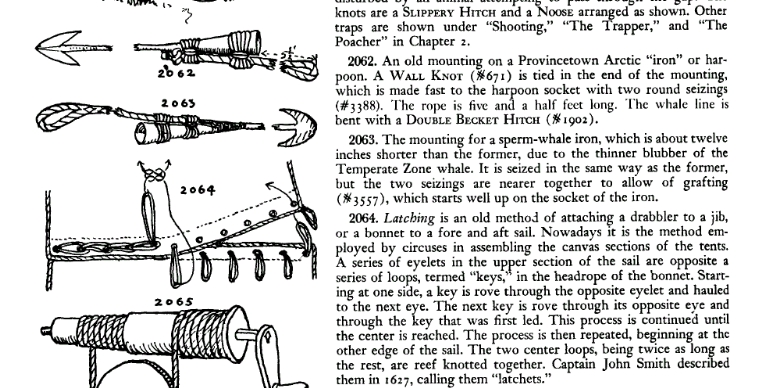
and 2063) making the mount on the handle
rather than the actual iron. "
(*The Ashley Book of Knots" by Clifford Ashley)
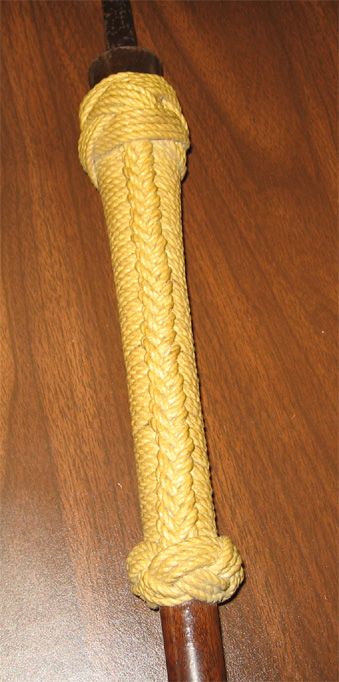


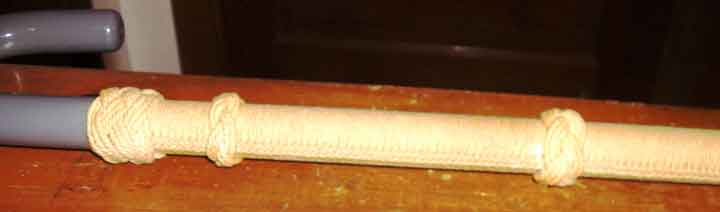
Gilbert and Sullivan tell us "A Policeman's Life Is Not A
Happy One." Well, a sailor's life, while happy, may not
necessarily be a safe one.
Chief had to get issued a cane after a recent injury and so,
like any true sailor who's laid up, he decided to "improve
the shining hour" with a bit of fancywork on his "third leg".
Happy One." Well, a sailor's life, while happy, may not
necessarily be a safe one.
Chief had to get issued a cane after a recent injury and so,
like any true sailor who's laid up, he decided to "improve
the shining hour" with a bit of fancywork on his "third leg".
Then, there's the bellropes. Every sailor who does knotting at some point will try his hand at turning out a bellrope or two. Chief
hadn't tried one of these and had been thinking about doing one when he ran across my tutorial on bellropes and decided to give it a
shot. The results are, even to the untrained eye, impressive, and to the trained eye they are the mark of a true devotee of the craft. I
would be proud to have any of his ropes aboard a vessel I commanded.
The bellrope is to the ship what the hat is to a Chief: along with the ship's bell, it ranks as the "heart" of the ship. It is probably the
most jealously guarded piece of equipment and the fancier the bellrope, the more prestige it gives to the vessel. They can range
from the purely functional to the almost obscenely ornate and from six inches long and straight up-and-down to one I saw (made for
HMS Ark Royal in the early 40's) which was three feet tall and took almost a year to complete. Needless to say, the more ornate are
kept in a safe place and only mounted for ceremonial occasions such as visits by Very High Brass or diplomatic port-calls. Sailors
who do these as gifts reserve them for those whom the most respect. To be given the bellrope from a ship (as was done for
Churchill and Roosevelt) is a mark of almost incredible respect.
hadn't tried one of these and had been thinking about doing one when he ran across my tutorial on bellropes and decided to give it a
shot. The results are, even to the untrained eye, impressive, and to the trained eye they are the mark of a true devotee of the craft. I
would be proud to have any of his ropes aboard a vessel I commanded.
The bellrope is to the ship what the hat is to a Chief: along with the ship's bell, it ranks as the "heart" of the ship. It is probably the
most jealously guarded piece of equipment and the fancier the bellrope, the more prestige it gives to the vessel. They can range
from the purely functional to the almost obscenely ornate and from six inches long and straight up-and-down to one I saw (made for
HMS Ark Royal in the early 40's) which was three feet tall and took almost a year to complete. Needless to say, the more ornate are
kept in a safe place and only mounted for ceremonial occasions such as visits by Very High Brass or diplomatic port-calls. Sailors
who do these as gifts reserve them for those whom the most respect. To be given the bellrope from a ship (as was done for
Churchill and Roosevelt) is a mark of almost incredible respect.

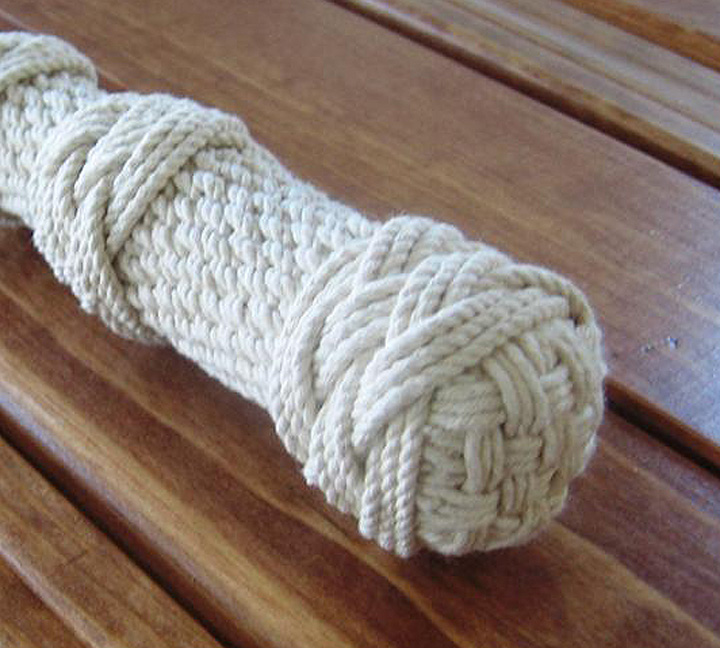
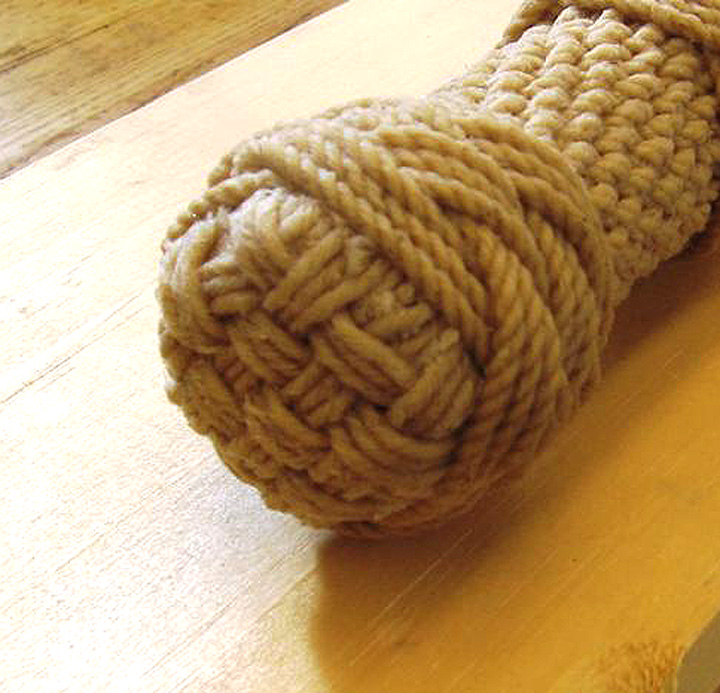
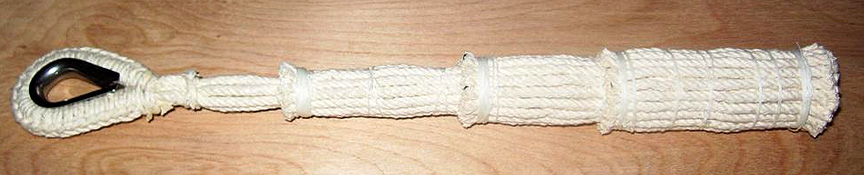
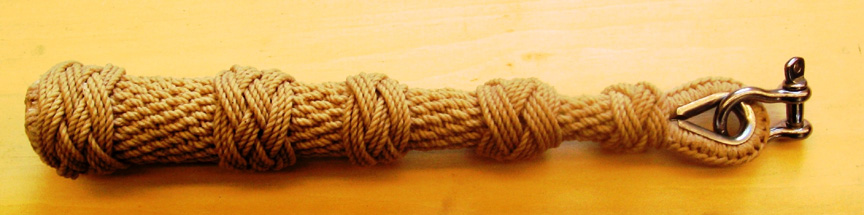
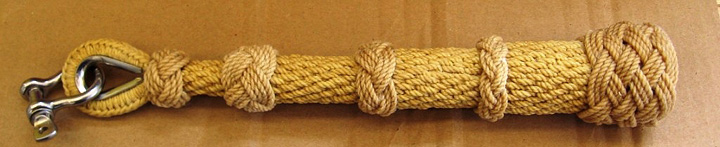

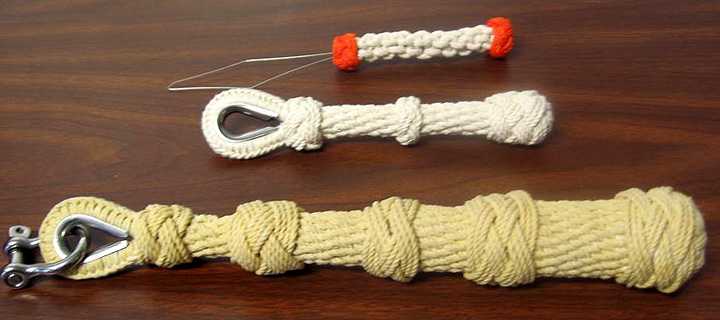
For those of you who may be interested in constructing a bellrope of
your own, let me refer you to my tutorial on the subject.
Chief Considine started out with a rope "pudding", or core for the
bellrope, with a coxcombed eye around a thimble (used to prevent
wear on the rope as the ship moves back and forth and the bellrope
necessarily moves against it), then he covered the pudding with the
"body" or "Casing" of the rope, finally adding the decorative
turksheads you see here... they go from a 3x5 at the small end to a 7x9
at the big end in order. (Nice touch!)
He also too the time and pains to "box" the end of the bellrope
(something rarely done anymore) by creating a mat across the end
and then locking that in with the larger turkshead. Very tricky to do
well.
your own, let me refer you to my tutorial on the subject.
Chief Considine started out with a rope "pudding", or core for the
bellrope, with a coxcombed eye around a thimble (used to prevent
wear on the rope as the ship moves back and forth and the bellrope
necessarily moves against it), then he covered the pudding with the
"body" or "Casing" of the rope, finally adding the decorative
turksheads you see here... they go from a 3x5 at the small end to a 7x9
at the big end in order. (Nice touch!)
He also too the time and pains to "box" the end of the bellrope
(something rarely done anymore) by creating a mat across the end
and then locking that in with the larger turkshead. Very tricky to do
well.
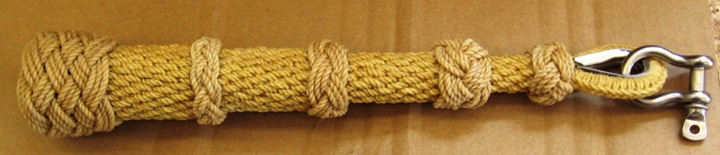
Then we have some pictures of the bellrope before and
after varnishing: you can see how much it has changed
the colour and appearance of the finished item.
Varnishing is a necessary evil: without it, salt spray and
the not-always-clean hands of the watchstanders would
deteriorate the work in a short time. Varnish, while it
changes the colour drastically, will preserve the bellrope
indefinitely. There is a varnished bellrope in the British
Museum which dates from the mid 16th century and
which may have been on Henry Tudor's flagship at one
time.
after varnishing: you can see how much it has changed
the colour and appearance of the finished item.
Varnishing is a necessary evil: without it, salt spray and
the not-always-clean hands of the watchstanders would
deteriorate the work in a short time. Varnish, while it
changes the colour drastically, will preserve the bellrope
indefinitely. There is a varnished bellrope in the British
Museum which dates from the mid 16th century and
which may have been on Henry Tudor's flagship at one
time.
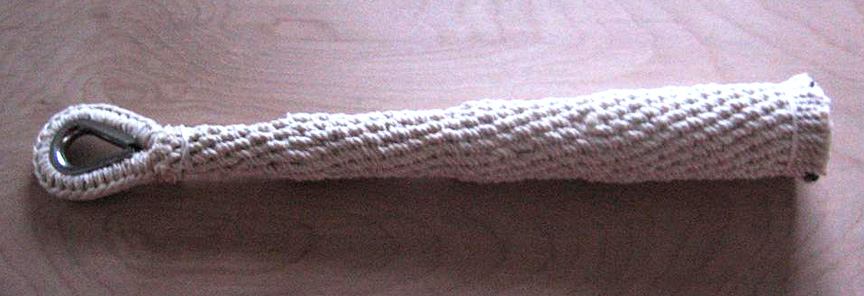
A small "straight" bellrope (also can be used for many other purposes
aboard ship) which would have been found on a ship's motor whaler or
cutter.
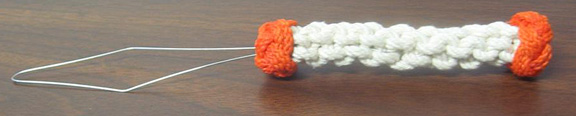
And, "our little family".... the bellrope above, the small bellrope and an
interesting tool... a line puller. We use these for dragging line thru
turksheads while building them, for tucking small decorative eyesplices
or... you name it. One of those tools which you can't figure out how you
got alone without it once you have one. This one is of .24AWG piano wire
which has been bent several times and the handle braided up around it.
Cheap, easy to make, invaluable and a perfect example of not only the
sailor's adaptability and inventiveness, but the perfect answer to, "What
am I gonna do with THIS stuff?"
aboard ship) which would have been found on a ship's motor whaler or
cutter.
And, "our little family".... the bellrope above, the small bellrope and an
interesting tool... a line puller. We use these for dragging line thru
turksheads while building them, for tucking small decorative eyesplices
or... you name it. One of those tools which you can't figure out how you
got alone without it once you have one. This one is of .24AWG piano wire
which has been bent several times and the handle braided up around it.
Cheap, easy to make, invaluable and a perfect example of not only the
sailor's adaptability and inventiveness, but the perfect answer to, "What
am I gonna do with THIS stuff?"

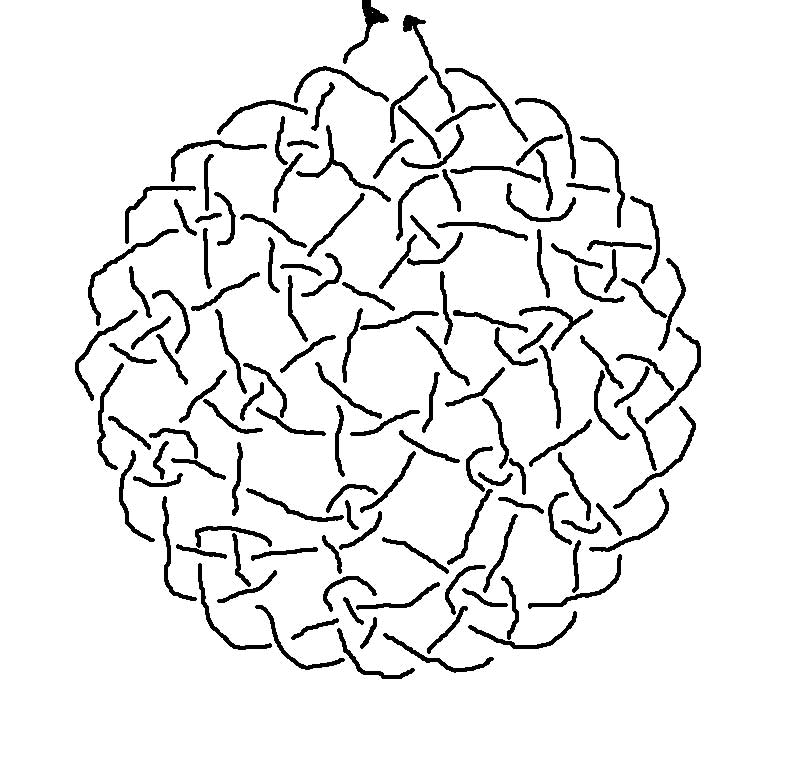
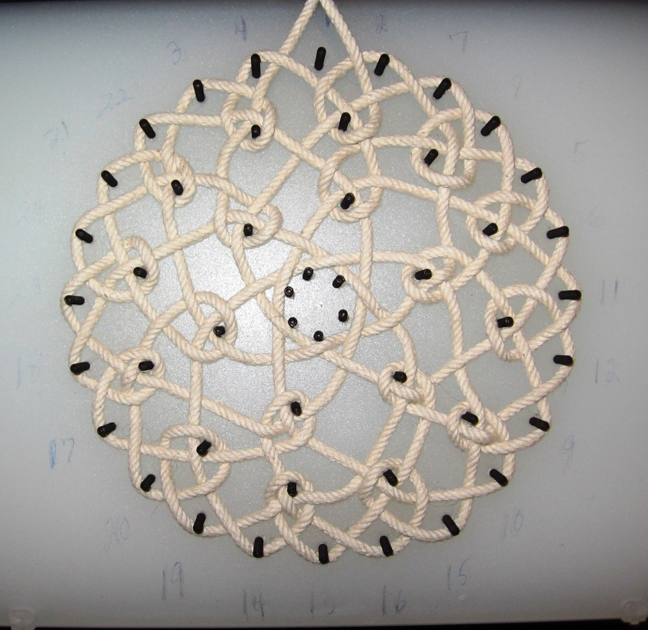

Above, left, is the outline chart used to set up the mat. You simply cannot do this without some sort of visual guide!
Above, right, is the first pass. Chief drilled some holes in a flat plastic sheet and used pegs to guide him in the initial layout as
well as marking the pass numbers on the plastic backing (see large picture).
Below, left, the second pass has been made. At this point, the pegs can be removed if you're feeling confident!
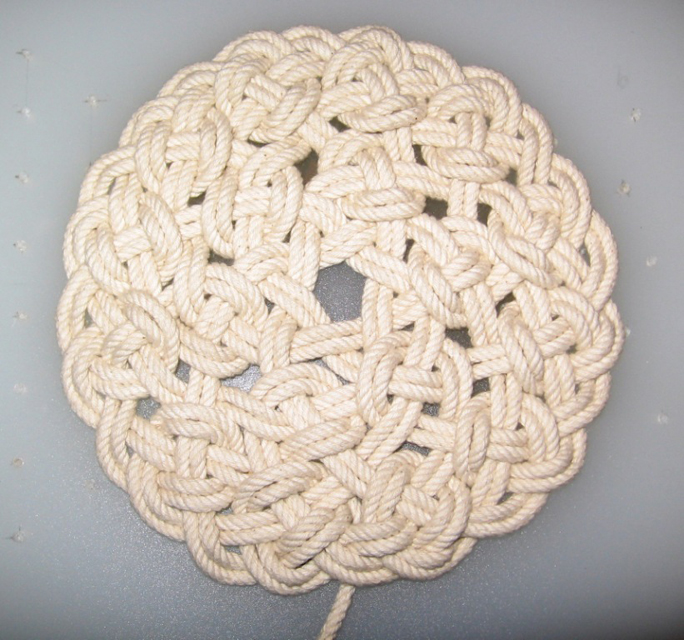
Below, right, is the mat as almost finished. It still needs to be pressed and have the ends tucked and sewn, but it's essentially
all tightened up and ready for presentation. 1/4" white cotton cord was used for the construction.
Above, right, is the first pass. Chief drilled some holes in a flat plastic sheet and used pegs to guide him in the initial layout as
well as marking the pass numbers on the plastic backing (see large picture).
Below, left, the second pass has been made. At this point, the pegs can be removed if you're feeling confident!
Below, right, is the mat as almost finished. It still needs to be pressed and have the ends tucked and sewn, but it's essentially
all tightened up and ready for presentation. 1/4" white cotton cord was used for the construction.
| All content these pages ©2004-2010 Frayed Knot Arts. All rights reserved. Reproduction or use prohibited without prior written permission. |