| Making a Knotting Table (or: How you too can take an innocent T. V. Table and make a weapon of mass inscrutability from it, in three easy steps.) |
| Last updated Jan 28 2016 |
Well, when you think about it, it's a lot easier to buggar up something that's already been built than it is to buggar up your
own creation from scratch.
So, I got meself some of those wooden T. V. tables in a set of four, with a lovely little rack for storing them, and all for about
$50 USD. They're available from TARGET, WALMART, KOHLS (usually), KMART, or any number of discount stores. It's a
standard "X" leg table and it's all wood. (The all-wood part is important.)
There are several interesting features here that need enumeration.
On the floor, I have a cheap-o rag rug (appx 60 CM x 1 M), the which are readily available at almost any Dollar Store", or at
WalMart, K-Mart, Target or other large discount stores. Usually they're about a dollar or so each and I'll use one for five or
six months and then just discard it when it gets too dirty to be sustainable. Buy five or six and store them.
This only applies if you're working on a hardwood floor. On concrete, I use a large piece of heavy cardboard (sold at most
packing stores to make irregular sized boxes or for mailing picture frames) instead. The rug allows one to slide the table
back or pull it forward without scratching or wearing the hardwood floor, as well as catching any drips (and there are many/
MANY drips!) of the superglue I'll discuss later. If your room has wall-to-wall carpeting, use the sheet of cardboard in
conjunction with the cheap rug. I can guarantee you that drips of superglue on carpeting are the best way possible to have
the local constabulary investigating your sudden and violent demise at the hands of your "Significant Other". DAMHIKT.
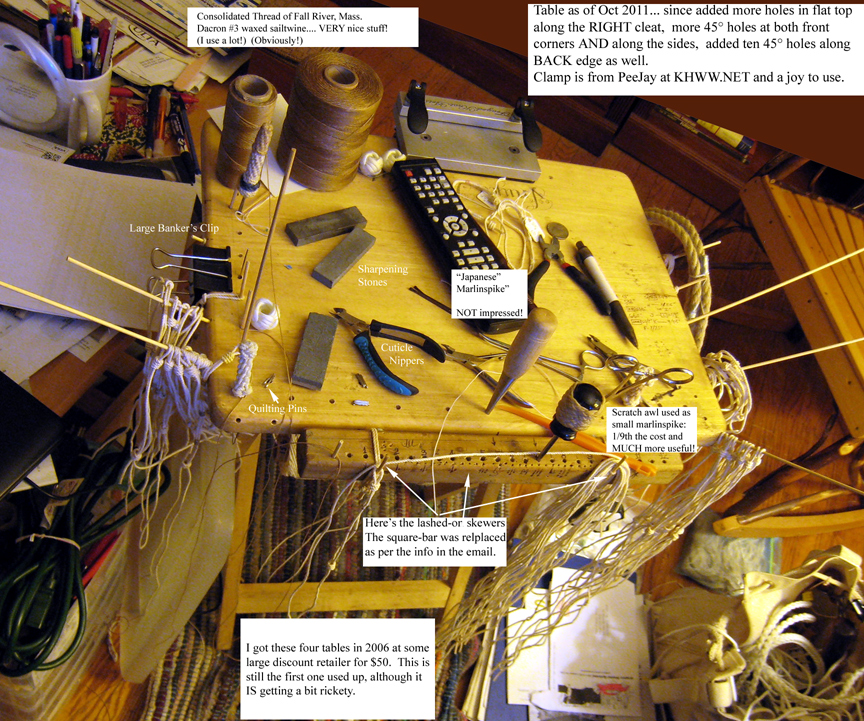
Along both short sides I have drilled six holes(REVISED: Make eight or ten holes per side!) at 40° above nadir (see the
picture and note the clipped skewers sticking out the side of the table top) the size of a medium bamboo skewer or a little
larger. From these skewers I support finished work, work in progress and rolls of line, suspending same from dowels
lashed so that I can get three rolls of line suspended vertically, usually two wide. In this iteration, the first dowel is quite a
bit longer than the top of the table and I could actually put four reels on that one alone.
In the front of the table, I took a piece of 1" x 1" oak railing stile and cut it to be the same thickness as the table top, then
drilled thru it in two places in the front and attached to the leading edge of the table with four washers between it and the
table's edge. (Provides clearance to pass a line or to sweep off the table-top)
(REVISED: I did not make the oak item the same length as the tabletop: I recommend you do so as it provides more working
area. If necessary, add a third screw/washer set in the center and space the other two out a bit more, as you may find
required for stability.)
Into the top of this false edge I have drilled two lines of holes, one series 1/4" apart and one series 3/8" apart from screw to
screw. I use these with the clipped skewers to support square knotting work. Also, I have lashed two skewers vertically on
the front of the bar just inboard the screws and I pass a long skewer under these lashings along the top and use that to
clamp any work that requires it. Also, at both ends along the top I have drilled holes which allow me to store my awls
vertically. (In the picture I have one sitting in once of the center holes, but they usually sit to the right in their own holes.)
For the holes in the bar, drill only about 3/4 of the way thru the bar...DON'T go all the way thru the workbar or your
skewers will drop out and be useless.
DAMHIKT
You'll also notice two turk's heads at either end of the bar.... It turned out they were more trouble than they were worth and I
no longer use them or the grommets.
(Let me say that if you find some cheap bamboo skewers of medium size, buy TEN PACKS of them and store them... you
will go thru a few each project. Good to have all the same size to fit the drilled holes.)
Along the top away from you (here, look for the multicoloured lines at the top of the table) you will see a black dot. There
are two of them, but the other is not visible on the other side of the table. Equally spaced under the dots are two larger
brass cuphooks. I use them when I do not have quite so much line suspended beneath the table and rig a harness which
allows me to suspend a bag or bucket in which I keep about 5# of weight. Either the weight OR the line will keep the very
lite table from tipping forward onto you when you are tugging on a piece of fancywork. (I find that my dittybags, loaded as
they usually are with a lot of tools, make a GREAT counterweight for this!)
ON the table you will see a white bottle-shaped object. This is my bottle of Super Glue (Cyano Acrylate) which I use for
everything from "tipping" lines to doing anti-frays, tacking the bottoms of bellropes prior to covering, sealing lashings that
will be covered by fancy work and the like. I find it totally indispensable, but you must always take into account that once it's
spilled it will not come off that surface unless you have some "debonder" and are lucky. Use it carefully and D O N ' T
B R E A T H E T H E F U M E S ! ! ! When working with this stuff, for Chrissake, DO IT OVER THE CARDBOARD OR THE
RAG RUG! (We went thru the "why" already, ain't?) I've had a rag rug become absolutely solid due to the amount of glue
dripped upon it. Consider the cardboard or rag rug like the sacrificial anode in your water-heater. It's not necessary, but
there will come a time when you are VERY glad you had it. DAMHIKT
NOTE: When using superglue you should (1) NOT work with it directly under your face so the fumes do not get into your
eyes or respiratory apparatus and (2) have a fan of some sort blowing ACROSS the work area to get the fumes away from
you and to promote the setting of the glue. Trust me, it really DOES help!
Have a good light over your right shoulder, preferably on a gooseneck so you can get highlights on the work, as well as a
good general lighting. I, predictably, have neither, but then, I'm already blind. The better the lighting, the easier the work.
Try to find a comfortable old chair that you don't mind getting the glue on. If it has exposed legs, so much the better, as
you can use the legs for tying off gripe points to hold one part of the work while you do another.
The other (and MOST important) accessories are: the TV and VCR/DVD remotes! I will ALWAYS have something on the
TV or radio... I can't STAND to work in a silent environment. I need something making noise (preferably intelligent) while I
work. Makes the time go faster.
Well, so much for MY table. The one in the picture is from 2006 and I'm still using it, taking it to shows for demonstrations
and am generally very pleased with the whole thing.
EXPERIMENT! Try something new to see if it works better for you than the above descriptions! If it does, let me know
about it!
If you'll go to the tutorials page you'll find links and suggestions for line and books, glue and support.
Let me know if there's anything else I can lie to you about.
Incidentally, DAMHIKT?
"Don't Ask Me How I Know That".
own creation from scratch.
So, I got meself some of those wooden T. V. tables in a set of four, with a lovely little rack for storing them, and all for about
$50 USD. They're available from TARGET, WALMART, KOHLS (usually), KMART, or any number of discount stores. It's a
standard "X" leg table and it's all wood. (The all-wood part is important.)
There are several interesting features here that need enumeration.
On the floor, I have a cheap-o rag rug (appx 60 CM x 1 M), the which are readily available at almost any Dollar Store", or at
WalMart, K-Mart, Target or other large discount stores. Usually they're about a dollar or so each and I'll use one for five or
six months and then just discard it when it gets too dirty to be sustainable. Buy five or six and store them.
This only applies if you're working on a hardwood floor. On concrete, I use a large piece of heavy cardboard (sold at most
packing stores to make irregular sized boxes or for mailing picture frames) instead. The rug allows one to slide the table
back or pull it forward without scratching or wearing the hardwood floor, as well as catching any drips (and there are many/
MANY drips!) of the superglue I'll discuss later. If your room has wall-to-wall carpeting, use the sheet of cardboard in
conjunction with the cheap rug. I can guarantee you that drips of superglue on carpeting are the best way possible to have
the local constabulary investigating your sudden and violent demise at the hands of your "Significant Other". DAMHIKT.
Along both short sides I have drilled six holes(REVISED: Make eight or ten holes per side!) at 40° above nadir (see the
picture and note the clipped skewers sticking out the side of the table top) the size of a medium bamboo skewer or a little
larger. From these skewers I support finished work, work in progress and rolls of line, suspending same from dowels
lashed so that I can get three rolls of line suspended vertically, usually two wide. In this iteration, the first dowel is quite a
bit longer than the top of the table and I could actually put four reels on that one alone.
In the front of the table, I took a piece of 1" x 1" oak railing stile and cut it to be the same thickness as the table top, then
drilled thru it in two places in the front and attached to the leading edge of the table with four washers between it and the
table's edge. (Provides clearance to pass a line or to sweep off the table-top)
(REVISED: I did not make the oak item the same length as the tabletop: I recommend you do so as it provides more working
area. If necessary, add a third screw/washer set in the center and space the other two out a bit more, as you may find
required for stability.)
Into the top of this false edge I have drilled two lines of holes, one series 1/4" apart and one series 3/8" apart from screw to
screw. I use these with the clipped skewers to support square knotting work. Also, I have lashed two skewers vertically on
the front of the bar just inboard the screws and I pass a long skewer under these lashings along the top and use that to
clamp any work that requires it. Also, at both ends along the top I have drilled holes which allow me to store my awls
vertically. (In the picture I have one sitting in once of the center holes, but they usually sit to the right in their own holes.)
For the holes in the bar, drill only about 3/4 of the way thru the bar...DON'T go all the way thru the workbar or your
skewers will drop out and be useless.
DAMHIKT
You'll also notice two turk's heads at either end of the bar.... It turned out they were more trouble than they were worth and I
no longer use them or the grommets.
(Let me say that if you find some cheap bamboo skewers of medium size, buy TEN PACKS of them and store them... you
will go thru a few each project. Good to have all the same size to fit the drilled holes.)
Along the top away from you (here, look for the multicoloured lines at the top of the table) you will see a black dot. There
are two of them, but the other is not visible on the other side of the table. Equally spaced under the dots are two larger
brass cuphooks. I use them when I do not have quite so much line suspended beneath the table and rig a harness which
allows me to suspend a bag or bucket in which I keep about 5# of weight. Either the weight OR the line will keep the very
lite table from tipping forward onto you when you are tugging on a piece of fancywork. (I find that my dittybags, loaded as
they usually are with a lot of tools, make a GREAT counterweight for this!)
ON the table you will see a white bottle-shaped object. This is my bottle of Super Glue (Cyano Acrylate) which I use for
everything from "tipping" lines to doing anti-frays, tacking the bottoms of bellropes prior to covering, sealing lashings that
will be covered by fancy work and the like. I find it totally indispensable, but you must always take into account that once it's
spilled it will not come off that surface unless you have some "debonder" and are lucky. Use it carefully and D O N ' T
B R E A T H E T H E F U M E S ! ! ! When working with this stuff, for Chrissake, DO IT OVER THE CARDBOARD OR THE
RAG RUG! (We went thru the "why" already, ain't?) I've had a rag rug become absolutely solid due to the amount of glue
dripped upon it. Consider the cardboard or rag rug like the sacrificial anode in your water-heater. It's not necessary, but
there will come a time when you are VERY glad you had it. DAMHIKT
NOTE: When using superglue you should (1) NOT work with it directly under your face so the fumes do not get into your
eyes or respiratory apparatus and (2) have a fan of some sort blowing ACROSS the work area to get the fumes away from
you and to promote the setting of the glue. Trust me, it really DOES help!
Have a good light over your right shoulder, preferably on a gooseneck so you can get highlights on the work, as well as a
good general lighting. I, predictably, have neither, but then, I'm already blind. The better the lighting, the easier the work.
Try to find a comfortable old chair that you don't mind getting the glue on. If it has exposed legs, so much the better, as
you can use the legs for tying off gripe points to hold one part of the work while you do another.
The other (and MOST important) accessories are: the TV and VCR/DVD remotes! I will ALWAYS have something on the
TV or radio... I can't STAND to work in a silent environment. I need something making noise (preferably intelligent) while I
work. Makes the time go faster.
Well, so much for MY table. The one in the picture is from 2006 and I'm still using it, taking it to shows for demonstrations
and am generally very pleased with the whole thing.
EXPERIMENT! Try something new to see if it works better for you than the above descriptions! If it does, let me know
about it!
If you'll go to the tutorials page you'll find links and suggestions for line and books, glue and support.
Let me know if there's anything else I can lie to you about.
Incidentally, DAMHIKT?
"Don't Ask Me How I Know That".

I just had occasion to send some similar information to a friend in Tasmania, having forgot this page until I was almost
done.
Interesting to compare them and see what I missed!
Well, he seems a well-spoken young fella and he's got some really good ideas! The "nails instead of skewers" is a nice
idea, but I prefer the bamboo... Don't have to worry about rusting! I use a small waste basket lined with one of those
eternally annoying plastic sacks from the grocers... Into this I can throw any trash, use it to catch drips when gluing and
the like, then toss the bag and get another... As for the hole in the table, I prefer to have the "long braid" disappear
over the far edge of the table rather than have somewhere that my small tools can take shelter from me. I never use
heat so that never occurred to me... Good idea, though...
Return to TUTORIALS PAGES
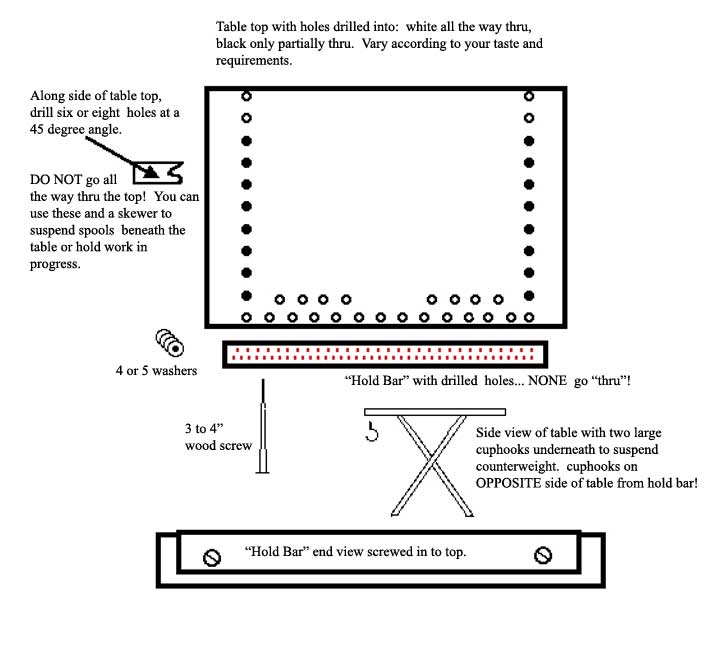
or 1-1/4" square exterior baluster rail (just drive about and find some berk doing deck-work... the small rail balusters are superb)
what is free from knots and warps, mark and drill holes sufficient to hold a medium-size bamboo skewer end in two lines. I used
English measure, drilling six holes per inch (well, maybe that really WAS a Whitworth straightedge!) and at 1/4" on the other line.
Drill about 5/8" in on this "hold bar" and you should need no other fancy grips or clamps other than the occasional "Banker's Clip" for
starting centre braids
Now, the table's edge is 18" (give or take) so centre the bar on the edge (I cut [ make that 'found'] 14" bars so that's what I used) so
about three inches in from each end of the table, then drill a 3" deep hole for a medium sized 4" deck screw, then drill a bit larger
hole thru the "hold bar", and get four or five 1/4" washers per side. Start the screw thru the hold-bar, put on the washers and screw
the assembly tight to the edge of the table, being sure that it's level with and just slightly higher than the tabletop. This will prevent
sharp round rolly things from plunging off the edge and embedding themselves in your (floor) (cat) (foot) (pick whichever apply).
If you use (as do I) a lot of awls, haemostats, prickers, small fids, or other of the aforementioned "sharp, round, rolly things", do as I
have and drill a myriad of just slightly differing diameter hols THRU the top of the table. Drill som 1" deep holes in a row along both
sides of the table's top in line with the cleats beneath, so that you go into but not through them and these make wonderful spindle
points for sailtwine spools or other things you'd like to live vertically so you can see them.
On both edges of the table, drill holes large enuf to take the medium skewer: do these at 45° above nadir and you will have a super
place to suspend rolls of line below the table (1). Do at least ten per side, neatly spaced.
Once you have attached the "hold bar" drilled all the extra little holes, explained to Lynn that this is really a useful as well as an ugly
addition to the living room, come back from the clinic and found that the table is NOT the most stabile item (I resemble that remark,
Sir!) in the house, obtain two medium size but GOOD quality screw-in cuphooks and attach then to the UNDERSIDE of the table
OPPOSITE the end that has the "hold bar" on it. From here you can suspend some weight (I use a ditty bag with my
unneeded-at-the-moment brass snaps and shackles) to keep the table from suddenly launching every-(censored)-thing on the
surface thereof, including any badly-placed skewers, directly into your frontal area. The rolls of line suspended (see (1) above)
below the table also help in this stability, but the ditty-bag-on-the-cup-hook routine is a true winner.
Really, that's all she wrote. It's a convenient height for most chairs, either fixed or folding, it folds flat and is a snap to transport, if
something happens to it, well, just get the next one (you bought four, d'ye ken?) and do another one.
A tip (and why I said in 4 inches for the screws): take about 18" of nice line you don't mind losing and a 4" length of skewer and
LASH it OUTBOARD the mounting screws on both sides. I do a loop lashing and then, when working on a square-knot belt or the
like, I can stick the belt across the bar and hold it as I pull on it with the skewers and the drilled holes, then slip an un-cut skewer
under the lashing, over the belt and under the other lashing.... now the belt (or whatever) is not moving in any of the six directions
that my non-mathematical mind cares to deal with.
Clear as mud, I'm quite sure.
A message from Sweden!!
what is free from knots and warps, mark and drill holes sufficient to hold a medium-size bamboo skewer end in two lines. I used
English measure, drilling six holes per inch (well, maybe that really WAS a Whitworth straightedge!) and at 1/4" on the other line.
Drill about 5/8" in on this "hold bar" and you should need no other fancy grips or clamps other than the occasional "Banker's Clip" for
starting centre braids
Now, the table's edge is 18" (give or take) so centre the bar on the edge (I cut [ make that 'found'] 14" bars so that's what I used) so
about three inches in from each end of the table, then drill a 3" deep hole for a medium sized 4" deck screw, then drill a bit larger
hole thru the "hold bar", and get four or five 1/4" washers per side. Start the screw thru the hold-bar, put on the washers and screw
the assembly tight to the edge of the table, being sure that it's level with and just slightly higher than the tabletop. This will prevent
sharp round rolly things from plunging off the edge and embedding themselves in your (floor) (cat) (foot) (pick whichever apply).
If you use (as do I) a lot of awls, haemostats, prickers, small fids, or other of the aforementioned "sharp, round, rolly things", do as I
have and drill a myriad of just slightly differing diameter hols THRU the top of the table. Drill som 1" deep holes in a row along both
sides of the table's top in line with the cleats beneath, so that you go into but not through them and these make wonderful spindle
points for sailtwine spools or other things you'd like to live vertically so you can see them.
On both edges of the table, drill holes large enuf to take the medium skewer: do these at 45° above nadir and you will have a super
place to suspend rolls of line below the table (1). Do at least ten per side, neatly spaced.
Once you have attached the "hold bar" drilled all the extra little holes, explained to Lynn that this is really a useful as well as an ugly
addition to the living room, come back from the clinic and found that the table is NOT the most stabile item (I resemble that remark,
Sir!) in the house, obtain two medium size but GOOD quality screw-in cuphooks and attach then to the UNDERSIDE of the table
OPPOSITE the end that has the "hold bar" on it. From here you can suspend some weight (I use a ditty bag with my
unneeded-at-the-moment brass snaps and shackles) to keep the table from suddenly launching every-(censored)-thing on the
surface thereof, including any badly-placed skewers, directly into your frontal area. The rolls of line suspended (see (1) above)
below the table also help in this stability, but the ditty-bag-on-the-cup-hook routine is a true winner.
Really, that's all she wrote. It's a convenient height for most chairs, either fixed or folding, it folds flat and is a snap to transport, if
something happens to it, well, just get the next one (you bought four, d'ye ken?) and do another one.
A tip (and why I said in 4 inches for the screws): take about 18" of nice line you don't mind losing and a 4" length of skewer and
LASH it OUTBOARD the mounting screws on both sides. I do a loop lashing and then, when working on a square-knot belt or the
like, I can stick the belt across the bar and hold it as I pull on it with the skewers and the drilled holes, then slip an un-cut skewer
under the lashing, over the belt and under the other lashing.... now the belt (or whatever) is not moving in any of the six directions
that my non-mathematical mind cares to deal with.
Clear as mud, I'm quite sure.
A message from Sweden!!
Thank you for a very nice and instructive site. I’m going to try to give something back by mentioning some of my own
ideas/experiences which might be of use to you.
I’ve set up my own workbench, although not as elaborate as yours, but it has a couple of features which I find immensely useful:
- A hole in the middle. Sometimes, when working with a long braid or something like that, it’s nice to just have someplace
where the end can disappear to reduce clutter.
- Rulers. I have the surface as a ruled cm-grid, with each 5 and 10 cm marked with heavier line. Very useful to reduce waste,
as you can learn how much rope you need (take extensive notes and learn from them!) and cut accordingly. Cool looking and
perhaps occasionally useful, a set of concentric circles around the center hole, also at cm intervals, just like the ruled grid.
- A hook to hang a garbage bag. It’s much less boring to clean up as you go than to do it afterwards…
- A holder for my soldering iron (just a couple of eye-bolts and a piece of sheet metal to protect my right knee). I usually work
with paracord or other nylon ropes, and it’s good to have a hot soldering iron ready, so I don’t have to wait for it to heat up.
- Instead of bamboo skewers, I simply use ordinary four inch nails with the tip filed blunt.
I also use some tools extensively which are not listed on your page:
- Calculator. Good rope is expensive as hell here, so I don’t want to waste it. A calculator helps me reduce waste.
- Tape measure. Used in combination with the calculator.
I would also suggest using piano wire for your line pullers. It will hold up much better.
Once again, thanks for an excellent site, it has been a great help for me as a beginner, and it’s a site I suspect I will come back to
over and over again.
Merry Christmas from Sweden,
Anders Troberg