| Fancywork on the rails and stanchions |

| Last updated 2017-04-07 |
| Click on any picture to bring up a larger verzion! |
There was a time when you could go aboard a Naval vessel of just about ANY Navy and never see
a bare railing or stanchion. They were all covered by coxcombing of one sort or another, whether
crosspoint or coachwhip work, turks heads or fancy round braids, as a matter of course.
If you DID see a bare rail, either the rail had just been repaired or installed/replaced, or you
were in the engineering spaces or inboard a submarine.
Submarines did not (and still do not) cover their rails and stanchions
with fancywork as it interfered with the rapid transfer of personnel
between decks... submariners are known for their habit of tucking the
rail into the armpit and sliding down to the next deck. On a surface ship,
this is agressively discouraged as the danger of being tossed to one
side in a heavy sea and losing your grip is (on everything but an aircraft
carrier) an ever-present danger.
Instead, surface vessels usually had one or more of a variety of rope wrappings on their rails to provide a secure hand-hold when
transiting from one deck to another. The complexity of these wraps (or coxcombs) and the condition in which they were maintained
was a not-inconsiderable source of pride for the Deck Department and they were usually quite assiduous about keeping them in
top-notch condition.
The only place where you would commonly NOT find these rail-wrappings was in the engineering
department's spaces. A "Deck Ape" would die before he volunteered to enter the "Black Gang's" territories and no self-respecting
"Snipe" would even think of inviting an "Anchor-Clanker" down there... so the rails in Engineering were usually polished for
appearance. (In point of fact, most of the rails in the Engineering area would eventually be replaced by brass tubing... acquired by
that wonderful Navy form of barter called "cumshaw") I remember being sent aboard a crusier once with a package for the
Engineering Officer (hand-deliver) and seeing the rails in the engine room looking like burnished gold.
But: our focus here is on the rails found aboard the USS Zuni (AT95) which later became the USCGC Tamaroa (WMEC 166). I got
involved with Zuni in October of 2006 when I got billeted aboard by the organizers of a knottying demonstration in Baltimore. Since
then, I've contributed a few small items to her upkeep and preservation and was fortunate enough to be permitted to take some
pictures of the rails as they presently exist aboard her.
As they presently exist, they're pretty sad. A lot of her rail work is still in fairly good
shape, but it's very old and should have been replaced twenty years ago. If she was
still a commissioned vessel, I've no doubt that they would have been, but the USCG retired her in 1994 after ten years of basically
letting her sit and die, so all the railwork is well past it's prime. Some of the rails appear to have been done in the late Fifties or
mid-Sixties from the amout of paint on them. Horizontal rails in particular have been the worst treated as the USCG stripped out the
equipment they wished to keep when she was decommissioned and rails were used as "sliding points", sometimes tearing up the
work.
Still, even in their present condition,they give a wonderful look at a vanishing skill and usage as most (as I am informed by others..
subject to correction, of course) modern Naval warships no longer have the work done, relying on painted textured surfaces to
provide a grip. It may be more efficient a use of time and material, but it will never equal the beauty of the older method.
In particular, note the two pics above left on the rail going up to the Bridge from the Radio level: these were done by an expert, fer
sure. The workmanship is extraordinarily good and they've been painted so many times that when first I saw them, I mistook them for
"leathering" rather than ropework. This particular set of rails MAY still have the original coxcombs from when she was first
commissioned in 1943 or very soon after... They are quite old. (On the left is a "Spanish" or "Ringbolt" Coxcomb and the "comb" has
been flattened out from thousands of hands gripping them over the years. A half-moku to the right.)
Here's a perfect example of something we find again and again in older vessels:
the original coxcomb was damaged somehow and the damaged part removed,
but there was no-one with sufficient skill aboard to repair the damage, or they
just didn't care about it and so substituted a bit of "French" coxcombing in a
different diameter line to "fill in" the damaged area. Call me a purist if you will,
but I'd have been horrified if I'd been a Bo'sun aboard her.
Here we have some pics of
a stanchion down in the
after crew's berthing area.
This was done as a
decorative item by the crew,
either while in- port or after
hours.
The upper stanchion is done
in a "French" coxcomb with
3/16 manila line and so is
probably from the Zuni's
"Navy" days. The lower
(brighter) wrap appears to
be of nylon line and is most
likely a repair since this
particular stanchion is
adjacent to the passageway leading back to the steering gear compartment in the orlop. The whole has been varnished with spar
varnish which gives it that golden yellow colour (as well as being slopped onto the lower part of the stanchion below that inordinately
large turkshead). As you can see from the air duct at the top of the stanchion, the varnishers were more enthusiastic than expert at
their craft.
The pictures here were taken with a little P.O.S. Kodak camera, so don't expect too much from them for clarity or depth!
Now that I've impressed you as a grouchy old fart, here's a nice story!
Zuni, when commissioned, had a lovely little wooden wheel for the helmsman to steer her by... it disappeared into the myriad of
re-models of the deckhouse which saw (among other idiocies) the teak floor replaced by cement (think for a second what THAT does
to your rolling moment... adding three tons of cement to a point 28 feet above the waterline... interesting concept. Hand me the
Dramamine, please?) and she ended up with a little brass wheel about 9" across on what looked like a half a telephone booth. Not
too pretty.
Harry Jaeger (Senior Chief Engineman and the Operations Director
of the Foundation today) was talking to a gent who did some wood-
work and mentioned that Zuni needed a wheel. The gent went back
to his workshop in the midwest and, using only a picture Harry
managed to find in an old magazine, constructed a wheel similar in
shape and diameter to the wheel on Zuni when commissioned, but he
also made it a work of art. He used five different types of wood, made
up a hub which fit the steering shaft from an old pedestal from another
"ATF" which had been scrapped, and generally did a bang-up job for Harry.
When asked how much he wanted for the wheel, he replied quietly,
"I've already been paid."
Zuni/Tamaroa's Operations Director, USS Zuni (ATF 95) / USCGC Tamaroa (WMEC 166)
Harry Jaeger, ENCS, USNret. "The US Coast Guard's Only Submarine"
"Instructing a visitor." (My "little" boy.)
REMEMBER HER. She'll become a fish-reef APR 28, 2017 and so
(as we like to think), will still be "at sea".
a bare railing or stanchion. They were all covered by coxcombing of one sort or another, whether
crosspoint or coachwhip work, turks heads or fancy round braids, as a matter of course.
If you DID see a bare rail, either the rail had just been repaired or installed/replaced, or you
were in the engineering spaces or inboard a submarine.
Submarines did not (and still do not) cover their rails and stanchions
with fancywork as it interfered with the rapid transfer of personnel
between decks... submariners are known for their habit of tucking the
rail into the armpit and sliding down to the next deck. On a surface ship,
this is agressively discouraged as the danger of being tossed to one
side in a heavy sea and losing your grip is (on everything but an aircraft
carrier) an ever-present danger.
Instead, surface vessels usually had one or more of a variety of rope wrappings on their rails to provide a secure hand-hold when
transiting from one deck to another. The complexity of these wraps (or coxcombs) and the condition in which they were maintained
was a not-inconsiderable source of pride for the Deck Department and they were usually quite assiduous about keeping them in
top-notch condition.
The only place where you would commonly NOT find these rail-wrappings was in the engineering
department's spaces. A "Deck Ape" would die before he volunteered to enter the "Black Gang's" territories and no self-respecting
"Snipe" would even think of inviting an "Anchor-Clanker" down there... so the rails in Engineering were usually polished for
appearance. (In point of fact, most of the rails in the Engineering area would eventually be replaced by brass tubing... acquired by
that wonderful Navy form of barter called "cumshaw") I remember being sent aboard a crusier once with a package for the
Engineering Officer (hand-deliver) and seeing the rails in the engine room looking like burnished gold.
But: our focus here is on the rails found aboard the USS Zuni (AT95) which later became the USCGC Tamaroa (WMEC 166). I got
involved with Zuni in October of 2006 when I got billeted aboard by the organizers of a knottying demonstration in Baltimore. Since
then, I've contributed a few small items to her upkeep and preservation and was fortunate enough to be permitted to take some
pictures of the rails as they presently exist aboard her.
As they presently exist, they're pretty sad. A lot of her rail work is still in fairly good
shape, but it's very old and should have been replaced twenty years ago. If she was
still a commissioned vessel, I've no doubt that they would have been, but the USCG retired her in 1994 after ten years of basically
letting her sit and die, so all the railwork is well past it's prime. Some of the rails appear to have been done in the late Fifties or
mid-Sixties from the amout of paint on them. Horizontal rails in particular have been the worst treated as the USCG stripped out the
equipment they wished to keep when she was decommissioned and rails were used as "sliding points", sometimes tearing up the
work.
Still, even in their present condition,they give a wonderful look at a vanishing skill and usage as most (as I am informed by others..
subject to correction, of course) modern Naval warships no longer have the work done, relying on painted textured surfaces to
provide a grip. It may be more efficient a use of time and material, but it will never equal the beauty of the older method.
In particular, note the two pics above left on the rail going up to the Bridge from the Radio level: these were done by an expert, fer
sure. The workmanship is extraordinarily good and they've been painted so many times that when first I saw them, I mistook them for
"leathering" rather than ropework. This particular set of rails MAY still have the original coxcombs from when she was first
commissioned in 1943 or very soon after... They are quite old. (On the left is a "Spanish" or "Ringbolt" Coxcomb and the "comb" has
been flattened out from thousands of hands gripping them over the years. A half-moku to the right.)
Here's a perfect example of something we find again and again in older vessels:
the original coxcomb was damaged somehow and the damaged part removed,
but there was no-one with sufficient skill aboard to repair the damage, or they
just didn't care about it and so substituted a bit of "French" coxcombing in a
different diameter line to "fill in" the damaged area. Call me a purist if you will,
but I'd have been horrified if I'd been a Bo'sun aboard her.
Here we have some pics of
a stanchion down in the
after crew's berthing area.
This was done as a
decorative item by the crew,
either while in- port or after
hours.
The upper stanchion is done
in a "French" coxcomb with
3/16 manila line and so is
probably from the Zuni's
"Navy" days. The lower
(brighter) wrap appears to
be of nylon line and is most
likely a repair since this
particular stanchion is
adjacent to the passageway leading back to the steering gear compartment in the orlop. The whole has been varnished with spar
varnish which gives it that golden yellow colour (as well as being slopped onto the lower part of the stanchion below that inordinately
large turkshead). As you can see from the air duct at the top of the stanchion, the varnishers were more enthusiastic than expert at
their craft.
The pictures here were taken with a little P.O.S. Kodak camera, so don't expect too much from them for clarity or depth!
Now that I've impressed you as a grouchy old fart, here's a nice story!
Zuni, when commissioned, had a lovely little wooden wheel for the helmsman to steer her by... it disappeared into the myriad of
re-models of the deckhouse which saw (among other idiocies) the teak floor replaced by cement (think for a second what THAT does
to your rolling moment... adding three tons of cement to a point 28 feet above the waterline... interesting concept. Hand me the
Dramamine, please?) and she ended up with a little brass wheel about 9" across on what looked like a half a telephone booth. Not
too pretty.
Harry Jaeger (Senior Chief Engineman and the Operations Director
of the Foundation today) was talking to a gent who did some wood-
work and mentioned that Zuni needed a wheel. The gent went back
to his workshop in the midwest and, using only a picture Harry
managed to find in an old magazine, constructed a wheel similar in
shape and diameter to the wheel on Zuni when commissioned, but he
also made it a work of art. He used five different types of wood, made
up a hub which fit the steering shaft from an old pedestal from another
"ATF" which had been scrapped, and generally did a bang-up job for Harry.
When asked how much he wanted for the wheel, he replied quietly,
"I've already been paid."
Zuni/Tamaroa's Operations Director, USS Zuni (ATF 95) / USCGC Tamaroa (WMEC 166)
Harry Jaeger, ENCS, USNret. "The US Coast Guard's Only Submarine"
"Instructing a visitor." (My "little" boy.)
REMEMBER HER. She'll become a fish-reef APR 28, 2017 and so
(as we like to think), will still be "at sea".



Just to show my heart's in the right place and my money is where my mouth is, go HERE to see a set of pictures proving that
the USN still understands tradition!.
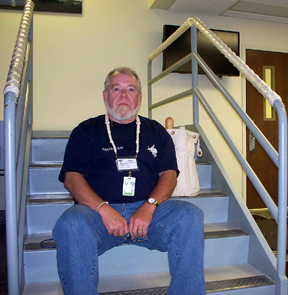
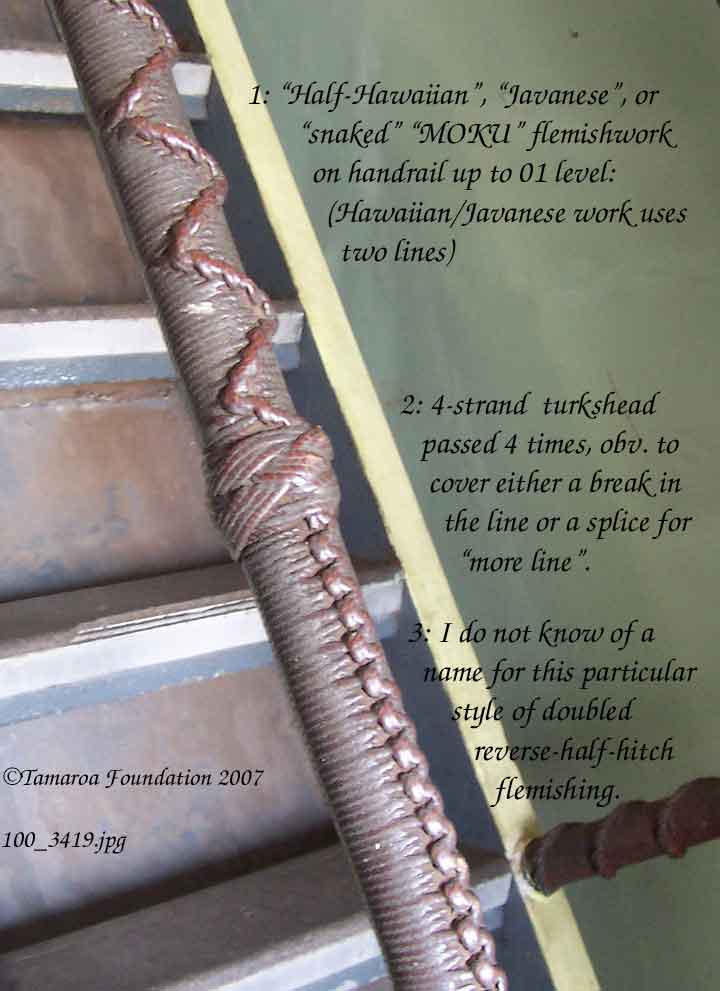
Seriously, that page (when done) will show the new rail wrappings
(St. Mary's Coxcomb) on the "Quarterdeck" stairwells at the Joint
Strike Fighter (F35) Development Centre at a Naval Air Station on
the east coast of the US.
The work is done in #45 (3/32") 4-strand left-laid cotton line obtained
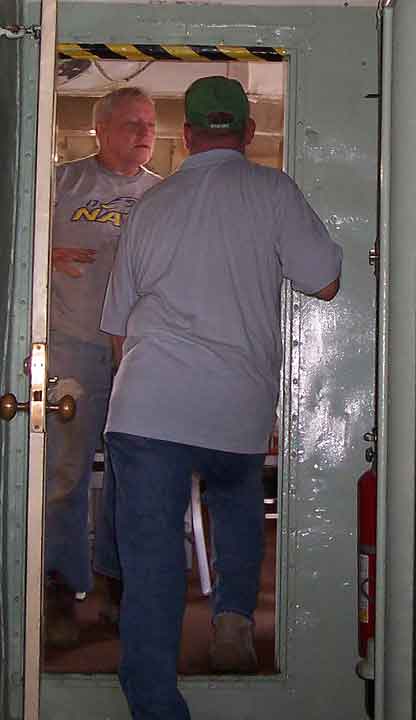
from KnotStuff.com and took FAR longer than it should have, as I had a
TON of Commissioned and Non-commissioned Officers "dropping by"
to see the work in progress. To be fair, most of these are "airdale"
types whose expertise does not encompass ropework of any sort,
but it was (and is) gratifying to see the interest still alive in the souls
of modern sailors.
the USN still understands tradition!.
Seriously, that page (when done) will show the new rail wrappings
(St. Mary's Coxcomb) on the "Quarterdeck" stairwells at the Joint
Strike Fighter (F35) Development Centre at a Naval Air Station on
the east coast of the US.
The work is done in #45 (3/32") 4-strand left-laid cotton line obtained
from KnotStuff.com and took FAR longer than it should have, as I had a
TON of Commissioned and Non-commissioned Officers "dropping by"
to see the work in progress. To be fair, most of these are "airdale"
types whose expertise does not encompass ropework of any sort,
but it was (and is) gratifying to see the interest still alive in the souls
of modern sailors.